02 Jul 2026
❄️Cool down your home with domestic air conditioning installation from BHE
Stay cool and comfortable during warmer months with domestic air conditioning installation by BHE’s trusted engineers in Wigan and Leigh. ...
Read more

400+ 5 STAR reviews on Google in Morecambe & Bolton!

04 Jun 2025
Liquefied Petroleum Gas, or LPG, is a popular, clean and safe fuel source for use in many different applications around the home and in holiday homes, including gas barbecues and other cooking equipment, patio heaters, portable heaters, some gas fires and gas cookers.
BHE answeres your Liquefied Petroleum Gas FAQs
BHE’s professional gas engineers regularly work with LPG gas equipment and appliances, ensuring gas safety throughout our customers’ homes and holiday homes in the North West, including Wigan, Leigh, Lancaster and Morecambe. In this article, our team answers some common questions about LPG, what it is and how it’s used!
LPG, or liquefied petroleum gas, is a form of fuel commonly used for heating and cooking appliances, for some industrial applications, to power some vehicles as ‘autogas’, and is used as a propellant and refrigerant in some applications.
This colourless, highly flammable gas is compressed into a liquid which makes it easier to store in cylinders and tanks and transport. If it leaks, LPG may settle and may accumulate in areas such as drains and basements, presenting a fire or explosion hazard.
LPG is stored and supplied in vessels including canisters, cylinders and bulk storage tanks, and is often considered a cleaner, lower-carbon energy source than other traditional energy sources.
LPG is used worldwide by millions of people for recreation, cooking, heating, and in commercial business, industry, transportation, agriculture and power generation.
BHE’s LPG engineers often find that our customers use LPG for cooking and heating around their homes in Wigan, Leigh, Lancaster and Morecambe, in appliances such as patio heaters, and particularly as a fuel for heating and cooking in holiday homes and static caravans. You’ll often access LPG for your appliances through a canister.
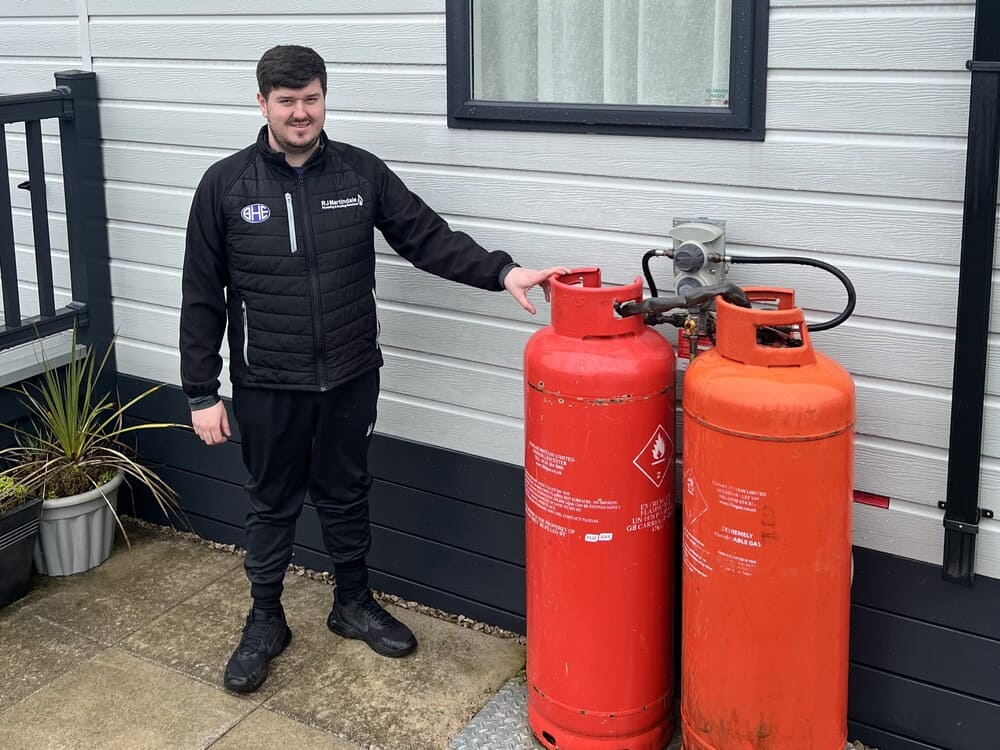
BHE engineer Connor after installing LPG canisters to supply a holiday home with gas, near Lancashire
LPG emits 33% less CO2 than coal and 12% less than oil. It also emits almost no black carbon, giving it a low carbon footprint compared with other types of domestic fuels commonly used by UK homeowners.
There are several benefits to using LPG as a heating fuel for your home or holiday home. It is a cleaner burning fuel than traditional heating sources, resulting in lower emissions and better air quality. LPG is reliable, burns more consistently and is also a more efficient fuel, meaning you can heat spaces in your home or holiday home using less fuel and potentially saving on energy costs.
Yes, LPG fuel can be used in conjunction with other heating systems, such as solar or geothermal. This can provide a backup heating source and potentially increase the overall efficiency of your heating system. It’s best to consult with a professional to determine the best heating setup for your home or holiday home’s specific needs – for example, access to other fuel sources, the size of your property and how you wish to use your heating system.
One of the most regularly-asked of all our LPG FAQs, users are usually aware that extra risks come with heating with LPG over mains gas.
Because of this, it is doubly important that LPG systems, and appliances which run using it, are regularly examined, as damaged or perished pipework and internal workings can cause a number of problems ranging from appliances running less efficiently to far more serious issues such as gas leaks or build-ups, both of which need to be dealt with as quickly as possible.
As with any heating system, it is important that you maintain and use your LPG heating system correctly to ensure safety. As with mains natural gas systems, you should have an LPG supply and equipment inspected regularly, and follow all safety guidelines provided by your supplier while using it. LPG contains a strong odorant to make leaks easier to detect.
As with boilers and other appliances which run on mains natural gas, all LPG appliances must be serviced by a registered gas engineer with necessary accreditations. LPG engineers must have obtained the CCLP1 qualification from the Gas Safe Register or, if they already hold the CCN1 natural gas qualification, obtain the CoNGLP1 changeover qualification which enables engineers to work on LPG installations.
The CCLP1 accreditation means that engineers are properly trained and accredited to work on LPG gas systems or appliances connected to them. It’s an important safeguard licencing anyone who works on ‘downstream’ gas systems and appliances – that is, which are installed in and serve homes or businesses.
BHE’s engineers, and those of our sister company RJ Martindale, hold the necessary qualifications to service, maintain and work with LPG appliances and heating systems.
It’s essential to have any repairs or servicing to your LPG gas supply and appliances connected to it carried out by an appropriately certified engineer.
For servicing or maintenance of LPG gas appliances and LPG systems, BHE’s recommended and highly-rated engineers in the Wigan, Leigh, Lancaster and Morecambe areas respond quickly, booking in your appointment and keeping your home or holiday home warm, comfortable and safe.
Installing, servicing or repairing LPG should be carried out by an accredited Gas Safe Registered engineer, ensuring your heating and cooking appliances are working safely and to their best. BHE's engineers throughout the North West are Gas Safe Registered, fully trained and accredited, giving you the reassurance you need that your home's in safe hands.
BHE is one of the North West’s most trusted LPG installation, servicing and repairs organisations, protecting homes, families and investments with fully-qualified, reliable and experienced heating and plumbing services.
With hundreds of five-star Google reviews for our work, our trusted team takes the heat out of caring for liquefied petroleum gas across the Wigan, Leigh, Lancaster and Morecambe areas.
Book your installation, service or repair with BHE’s local team of Gas Safe Registered engineers.
02 Jul 2026
Stay cool and comfortable during warmer months with domestic air conditioning installation by BHE’s trusted engineers in Wigan and Leigh. ...
13 May 2026
With summer quickly approaching, having a reliable water supply outside is essential for the average UK household, especially if you're somebody who loves to enjoy and maintain their garden....
27 Apr 2026
LPG, or Liquefied Petroleum Gas, is widely used as a fuel in many situations where there is no mains gas supply, or to supplement this in appliances which often only see temporary use, such as portabl...
2026© B.H.E. SERVICES (BOLTON) LIMITED. Privacy Policy | Cookie Policy | Website Terms of Use | Sitemap
